
Maruti Suzuki India Ltd, the country's biggest carmaker, is set to play a larger role in the operations of parent Suzuki Motor and will contribute a third of the Japanese company's global sales by 2009-10, the Indian firm's managing director Shinzo Nakanishi said on Thursday.

Hyundai Motor India Ltd has become the country's fifth most valuable auto firm by market valuation in its debut trade on Tuesday. Shares of Hyundai Motor India Ltd, the Indian arm of South Korean automaker Hyundai, listed at Rs 1,931, reflecting a decline of 1.47 per cent against the issue price of Rs 1,960 on the BSE earlier in the day. The stock slumped 7.80 per cent to Rs 1,807.05 during the day and finally ended at Rs 1,820.40 apiece, down 7.12 per cent.

Maruti Suzuki India Ltd is not contemplating any price raise, despite a 20-30 per cent surge in raw material prices in recent months.
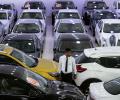
Traversing from being just vehicle manufacturers to mobility solutions providers amid a raging debate over which eco-friendly technology must be incentivised, the Indian automobile industry is driving in the new year under the shadow of a slowdown in sales with the post-pandemic pent-up demand in distant memory. The shift in the auto industry -- where advanced technologies like autonomous driving, vehicle intelligence, connected features and electrification are quickly gaining traction -- will be reflected in the upcoming Bharat Mobility Global Expo in which India's flagship Auto Expo has been clubbed to be held from January 17-22, 2025 in Delhi-NCR.

For the first time, the event will take place across three locations in Delhi: Bharat Mandapam at Pragati Maidan, Yashobhoomi Convention Centre at Dwarka, and India Expo Mart at Greater Noida.

Passenger vehicle retail sales witnessed 3 per cent on-year decline in May with customers delaying purchases in several states due to India-Pakistan conflict and further softening of demand for entry-level models, dealers' body FADA said on Friday. The passenger vehicle registrations last month stood at 302,214 units, as compared to 311,908 units in May 2024.

Gulveer Singh clocked 28 minute 38.63 seconds to win the gold to claim the gold medal in the men's 10,000m race at the Asian Athletics Championships.
Car market leader Maruti Suzuki India's July sales remained almost flat at 58,543 units as against 57,909 units in the same month last year.
Shinzo Nakanishi, the 65-year-old managing director and chief executive officer (CEO) of Maruti Suzuki India Ltd (MSIL), spent the better part of last week visiting and apologising to injured colleagues across half a dozen hospitals in Gurgaon, Haryana.

Maruti Suzuki on Thursday reported 6.54 per cent increase in sales at 1,18,949 units for February. The company had sold 1,11,645 units in the same month last year.

The initial public offer of Hyundai Motor India Ltd, the Indian arm of South Korean automaker Hyundai, received an 18 per cent subscription on the first day of bidding on Tuesday. The Rs 27,870 crore initial share sale received bids for 1,77,89,457 shares against 9,97,69,810 shares on offer, as per NSE data. The IPO received over 9 lakh applications on the first day.
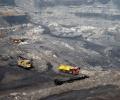
The 17 rare earth elements that are at the centre of the current crisis are critical components of everyday products -- from cars to jet engines to electronics like smartphones and flat-screen TVs.
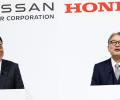
Two Japanese auto giants, Honda and Nissan, are moving towards a potential merger, but it remains unclear how their Indian operations will be immediately impacted.
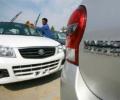
In terms of volumes, sales were down by 9.98 per cent to 266,343 units.
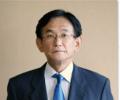
The appointment will be effective from April 1.

In October, MSI recorded domestic sales of 96,002 units compared to 51,458 units in the year-ago period, registering a rise of 86.56 per cent, it added.

In terms of volumes, sales were up by 19.6 per cent to 2,75,586 units compared 2,30,376 to the year-ago period.

Benchmark equity indices Sensex and Nifty pared early gains to settle lower on Wednesday due to late selling in index major Reliance Industries, ITC and HDFC Bank even as the RBI took the first step towards a rate cut in its monetary policy review. Erasing its early gains, the 30-share BSE Sensex fell 167.71 points or 0.21 per cent to close at 81,467.1. During the day, it surged 684.4 points or 0.83 per cent to hit an intra-day high of 82,319.21.

The company had sold 85,565 units in the same month last year.

Fada estimates that global supply chain headwinds like scarce availability of rare earth elements for electric vehicle components and geopolitical tensions may affect urban consumer sentiment in June as well.
The three companies would jointly invest in setting up a manufacturing unit at Manesar in Haryana, expected to be operational by end of calendar year 2008. The facility, when fully operational, would have a capacity to produce five lakh units per annum, MSIL said in a statement.

The country's largest carmaker Maruti Suzuki India on Tuesday said its models Swift, Baleno, WagonR, Alto and Dzire have emerged as best selling cars in 2020-21 and the top five models have come from its stable for the fourth consecutive year. Swift with over 1.72 lakh units was at the number one position followed by Baleno with 1.63 lakh units, the company said in a statement. Maruti Suzuki India's (MSI) tall boy WagonR was in the third spot with 1.60 lakh units while Alto and Dzire were at fourth and fifth with 1.59 lakh units and 1.28 lakh units respectively, it added.

Maruti Suzuki India on Tuesday said it is recalling 9,125 units of its models Ciaz, Brezza, Ertiga, XL6 and Grand Vitara to fix possible defects in a part of the front row seat belts. The affected vehicles were manufactured between November 2-28, 2022, Maruti Suzuki India said in a regulatory filing.

Auto majors report positive sales figs for November.

From the Sensex pack, Tata Motors, NTPC, Bajaj Finserv, Power Grid Corp, Titan, Asian Paints, IndusInd Bank, Maruti Suzuki India and Tata Steel were among the biggest gainers. Sun Pharmaceuticals, ITC, Hindustan Unilever, Bharti Airtel, UltraTech Cement and Reliance Industries were among the laggards.

The country's largest car maker Maruti Suzuki India on Monday said its cumulative exports have crossed one million units with the milestone car headed for Denmark.
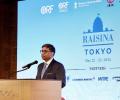
India's Foreign Secretary Vikram Misri has underscored the importance of not equating the victims and perpetrators of terror attacks, highlighting the need for global unity in combating terrorism. Speaking at Raisina Tokyo 2025, Misri expressed appreciation for Japan's support following the recent terror attack in Pahalgam, India. He also cautioned against the trend of some Western countries hyphenating India and Pakistan in the context of their recent military confrontation. Misri further outlined India's economic aspirations and its commitment to becoming a factor of stability in a turbulent world.

Internship opportunities have been posted by 193 companies, including Jubilant Foodworks, Maruti, Eicher Motor, L&T, Muthoot Finance and Reliance.
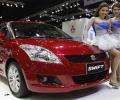
Maruti Suzuki India (MSI) on Wednesday reported over two-fold jump in its consolidated net profit to Rs 1,036 crore for the first quarter ended June 30, mainly due to a low base in the year-ago period. The auto major had posted a net profit of Rs 475 crore in the COVID-hit April-June quarter of the last fiscal. Its net sales rose to Rs 26,512 crore in the June quarter compared to Rs 17,776 crore in the same period of 2021-22.

The country's largest carmaker Maruti Suzuki India (MSI) on Thursday reported 2.04 per cent increase in its consolidated net profit for the second quarter at Rs 1,419.6 crore on the back of higher sales. The auto major had posted a net profit of Rs 1,391.1 crore in the July-September quarter of the previous fiscal.

Suzuki has made a great comeback in the 150cc segment with the launch of the Gixxer motorcycle; it's among the top sellers in the segment currently, says Indian automobile website MotorBeam.

Maruti Suzuki India said it would be investing Rs 1,250 crore (Rs 12.50 billion) to double capacity at its K-series petrol engine unit in Gurgaon to 500,000 by 2012.

Data collated for 47 BSE50 companies (as of H1FY25) shows employees and workers filed 8,468 such complaints in FY24.

The company's net sales rose about 12 per cent to Rs 1,465 crore (Rs 14.65 billion).
India's car market leader Maruti Suzuki India unveiled two concept models - sedan Ciaz and crossover SX4 S-Cross - as it looks to enhance its position in the bigger sedan segment going forward.

The first luxury car will be launched in the first quarter of 2025 and the company is planning to open 12 'MG Select' showrooms in the next six months.
The company had posted a net profit of Rs 465.85 crore (Rs 4.65 billion) in the April-June period in 2008, Maruti Suzuki India said in a filing to the Bombay Stock Exchange.
Prices of various car models -- ranging from entry-level hatchbacks to high-end luxury offerings -- are set to rise as automakers have announced price hikes with effect from January. Carmakers cite an increase in input costs and operational expenses as the main reason to implement price increases from the next month. Industry experts, however, note that the exercise is also undertaken by automakers every year in December to shore up sales volume in the last month of the year, as customers postpone buyouts to later months to get the new year manufactured units.

Stock markets snapped their five-day losing run on Friday with the benchmark BSE Sensex closing higher by 75 points on value-buying in banking and oil shares after recent losses. The 30-share BSE Sensex rose by 75.71 points or 0.10 per cent to settle at 73,961.31. During the session, it hit a high of 74,478.89 points and a low of 73,765.15 points.
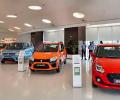
Maruti Suzuki India on Monday said it has hiked prices of its vehicles across models by about 1.1 per cent. This is the second price hike that the carmaker is undertaking in the ongoing fiscal year, after increasing it in April 2022. In December last year, the company had said it would hike prices of its vehicles to offset the impact of rising input costs and make provisions to update the model range to conform to stricter emission norms which will kick in from April 2023.
